Discover Captain Cook's Landmarks in Gisborne
Updated: Jun 11
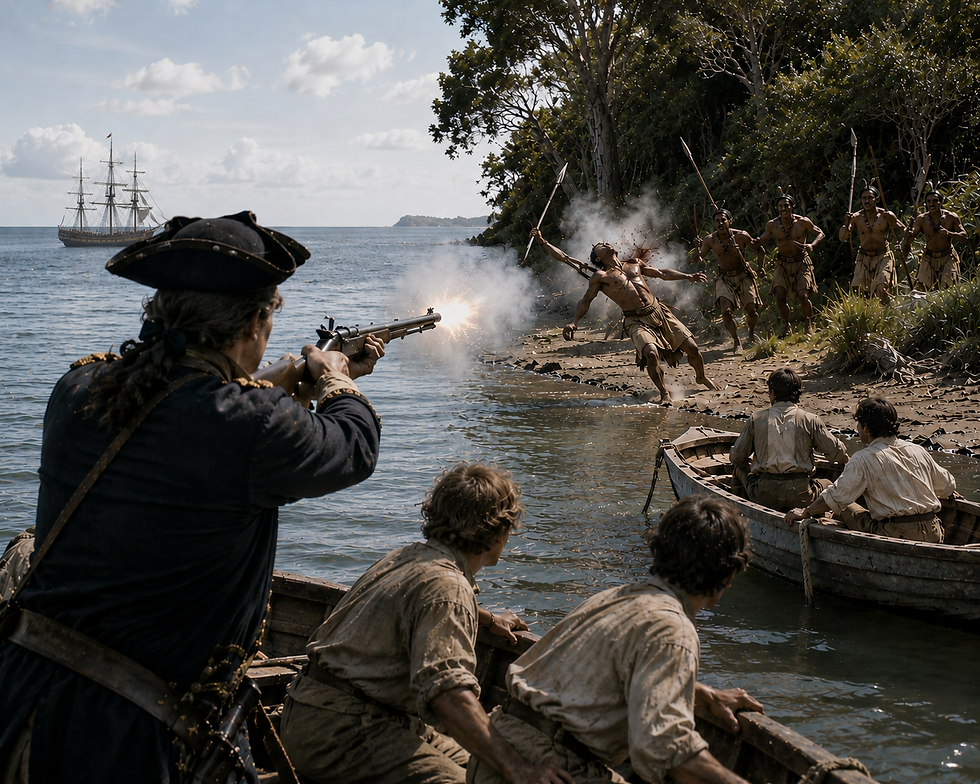
Cook Statue, Waikane Beach, Gisborne NZ Depiction of Cook's Landing Cook's Monument, Cook Landing National Reserve, c1906, Gisborne NZ Cook Landing National Reserve, Present day, Gisborne NZ
Most visitors arrive in Gisborne for the beaches, sunshine, surf, wineries, or relaxed East Coast atmosphere.
But beneath the modern city sits one of the most historically important landscapes in New Zealand.
This was where Captain James Cook and the crew of the Endeavour first landed in October 1769. It was also the site of the first sustained encounters between Māori and Europeans on New Zealand soil.
More than 250 years later, traces of those events still remain scattered across Gisborne.
Some are obvious.
Others require a closer look.
And some have partially disappeared beneath modern redevelopment, port reclamation, and changing attitudes toward New Zealand’s colonial history.
For visitors interested in history, Gisborne offers one of the country’s most fascinating self-guided historical journeys.
But it also raises an uncomfortable question:
Why does one of the most globally significant moments in New Zealand history now feel so understated in the very city where it occurred?
If Cook had first landed in:
Hawaii
Tahiti
Australia
the United States
or parts of Europe
would the site today be treated as a major international heritage destination?
Would the original shoreline have been protected?
Would the arrival route have been preserved?
Would there be museums, reconstruction projects, harbour tours, visitor centres, and globally marketed heritage experiences built around it?
In Gisborne, the answer feels less clear.
Part of that may reflect modern political discomfort surrounding colonisation and empire.
Part may simply reflect Gisborne itself: a relaxed, isolated city that has never aggressively commercialised its own history.
To a first-time visitor to Gisborne this may seem unusual. However, after spending time here, discovering why this may be so becomes an intriguing story in itself.
One of the most historically important first-contact locations in the Pacific is simultaneously:
nationally significant
politically contested
physically altered
and strangely underdeveloped as a major heritage attraction.
Let’s begin a fascinating historical journey into Cook’s first landing.
Kaiti Hill Overview of Cook’s Landing
Start tour at Kaiti Hill.
This is the single best place to understand the geography of Cook’s arrival.
A short drive up to the summit lookout and carpark allows visitors to see:
Poverty Bay
the Tūranganui River mouth
the harbour approaches
and the modern port reclamation areas
Standing here helps explain why Cook anchored offshore in 1769 and how the surrounding landscape shaped the first encounters.
The view also reveals something many visitors do not initially notice:
The original landing environment has been heavily altered.
Large sections of modern port infrastructure and reclaimed industrial land now sit between the historic reserve that mark the first landing and the sea itself.
Historically, Kaiti Hill also contained the famous “Crook Cook” statue installed during the 1969 bicentenary commemorations.
That statue was removed in 2019 following years of political and cultural debate surrounding colonial monuments.
Its absence is now part of the historical experience itself.
Visitors may quietly wonder:
Would a city elsewhere in the world remove one of its most recognisable monuments connected to such a globally known explorer?
Or would it preserve, update and contextualise it instead?
After quiet reflection, head down to the Cook Landing Historic Reserve.
Cook Landing Historic Reserve
This remains the symbolic national centre of Cook’s landing in New Zealand.
Here you will find:
the 1906 Cook obelisk
interpretive history panels
memorial installations
carved pou
and the modern Te Ikaroa a Rauru waka structure
The reserve today presents a layered interpretation of history.
Originally, the site functioned solely as a memorial to Cook’s arrival, with the obelisk as the centrepiece.
This national monument was largely paid for by ordinary New Zealanders. Schoolchildren across the country donated pennies toward the monument fund, alongside patriotic local fundraising groups and a modest government contribution.
More recently, government, council, and institutional funding drove the post-2019 Tuia 250 redevelopment of the reserve to place stronger emphasis on:
Māori navigation traditions
ancestral waka migration
Ngāti Oneone cultural history
and the violent first encounters between Māori and Cook’s crew
The most dominant structure is now Te Ikaroa a Rauru, a massive 6.3 metre-high pedestrian bridge shaped like a traditional waka, completed as part of the Tuia 250 redevelopment.
The structure spans Kaiti Beach Road and physically links the reserve with Kaiti Hill.
Its design incorporates Māori navigational symbolism and references approximately 1000 years of Polynesian settlement before European arrival.
For many visitors, this dramatically changes the visual character and original intent of the reserve.
The Cook obelisk, completed in 1906, still stands, but it now occupies a comparatively secondary visual role within a much larger cultural installation landscape.
Supporters view this as overdue historical balance.
Critics see it as the gradual overshadowing of Cook himself within the very reserve originally established to commemorate his landing.
Today, the relationship between the landing site and the ocean has been significantly interrupted.
Port reclamation over the 20th century pushed the shoreline outward and replaced much of the original foreshore with:
industrial land
log yards
shipping infrastructure
and concrete harbour works
As a result, visitors standing near the Cook monument can no longer properly experience the original maritime setting of the landing, with the original relationship between the monument and shoreline now lost.
Ironically, while public debate often focuses on statues and historical symbolism, the largest physical alteration to the site came from industrial reclamation itself.
This is perhaps the strangest aspect of Gisborne’s relationship with its own history.
The city possesses one of the most important historical landscapes in New Zealand, yet large sections of the original setting have been casually overtaken by industrial expansion and overshadowed by newer cultural installations.
The images preceding this article clearly depict this by comparing a colorised image of the 1906 unveiling ceremony at the reserve with an image as it is today.
Elsewhere in the world, many comparable first-contact sites would likely be treated as sacred national heritage zones.
In Gisborne, forklifts, log yards, and shipping infrastructure now dominate much of the foreground.
After exploring the reserve, spend some time along the modern Gisborne waterfront.
Captain James Cook Statue
Head to Waikanae Beach Reserve near the city side of the Tūranganui River mouth.
Here stands the modern Captain James Cook statue erected in 2000.
The bronze monument commemorates Cook’s first landing and the arrival of the Endeavour in October 1769.
Nearby visitors can also see:
the Nicholas Young statue
open views toward Young Nick’s Head
and the harbour entrance Cook’s crew first approached
The Cook statue has itself become part of modern New Zealand’s historical debate.
It has been vandalised several times over recent years amid wider tensions surrounding colonial monuments and historical interpretation.
For visitors, that controversy now forms part of the historical landscape.
These sites no longer exist outside politics or cultural debate.
They actively reflect it.
The river mouth remains one of the best surviving physical references to the Endeavour’s arrival.
Walking the waterfront allows visitors to visualise:
longboats moving ashore
the Endeavour anchored offshore
and the narrow coastal geography that shaped the first encounters
The surrounding landscape still resembles many of the early sketches and journals from the voyage.
Yet there remains surprisingly little tourism infrastructure explaining this to visitors in a comprehensive way.
No major museum dominates the waterfront.
No immersive reconstruction experience exists.
No globally recognisable heritage precinct has emerged around the landing itself.
Perhaps that reflects politics.
Or perhaps it simply reflects Gisborne’s famously laid-back personality:
A place more interested in beaches, surf, sunshine, and lifestyle than aggressively packaging its own historical importance.
Young Nick’s Head
From most vantage points along Gisborne’s town beaches, including Waikanae and Midway, Young Nick’s Head can be seen in the distance.
This dramatic headland was first sighted by Nicholas Young aboard the Endeavour, making it one of the earliest named landmarks associated with European arrival in New Zealand.
The coastline here remains one of the closest surviving visual connections to the world Cook encountered in 1769.
Unlike monuments, plaques, or memorials, the landscape itself has endured.
Standing near the headland at sunset gives visitors perhaps the clearest emotional connection to the voyage:
the isolation
the scale of the coastline
the navigational challenge
and the sense of entering an unfamiliar world
The Missing Endeavour Replica Ships
Like the “Crook Cook” statue, much of Gisborne’s story surrounding Cook memorials is about what is no longer there.
Endeavour replica boats, connected to the 1969 bicentenary, once stood along the city’s main thoroughfare, Gladstone Road.
The replicas were not nationally famous installations. They were symbolic civic features that contributed to the city’s historical atmosphere.
What is notable is not simply that the replicas disappeared, but that there appears to have been:
little public discussion about their removal
minimal heritage preservation effort
and almost no formal historical record explaining when or why they vanished
That absence fits a broader pattern surrounding Cook memorialisation in Gisborne over recent decades:
the removal of the “Crook Cook” statue from Kaiti Hill
the overshadowing of the original obelisk by newer installations
the loss of shoreline visibility through port reclamation
and the gradual fading of smaller Cook-related civic symbols from public space
In another country, small historical features connected to the first landing of a globally recognised explorer may well have been:
restored
heritage-listed
incorporated into tourism trails
or recreated as part of a larger historical precinct
In Gisborne, the replicas seem to have quietly disappeared into civic memory with little resistance or institutional concern.
Conclusion
Following Cook’s landing sites across Gisborne is not simply a sightseeing itinerary.
It is an exploration of how New Zealand remembers, debates, reshapes, and physically alters its own history.
Some visitors will see:
exploration
navigation
scientific achievement
and the beginning of modern New Zealand
Others will focus on:
colonisation
violence
dispossession
and cultural loss
That complexity is precisely what makes Gisborne unique.
Cook’s landing has become a historical experience where visitors are often left to draw their own conclusions. This has made this visitor attraction raw and authentic. Visitors are made to self-reflect and discover for themselves the enormity of what took place.
But Gisborne also leaves visitors with another lingering impression: a sense that the city itself remains oddly indifferent toward one of the most historically significant events ever to occur on its shores.
Whether that reflects:
modern political correctness
discomfort with colonial history
or simply Gisborne’s relaxed and understated personality
is open to interpretation.
What is undeniable is this:
Few places in the South Pacific played a larger role in changing New Zealand’s trajectory than this coastline.
And few places have treated such globally important history with such a curious mixture of remembrance, alteration, controversy, neglect, and quiet understatement.