
First Landing: What Happened When Cook Stepped Ashore in Gisborne
Updated: Sep 12
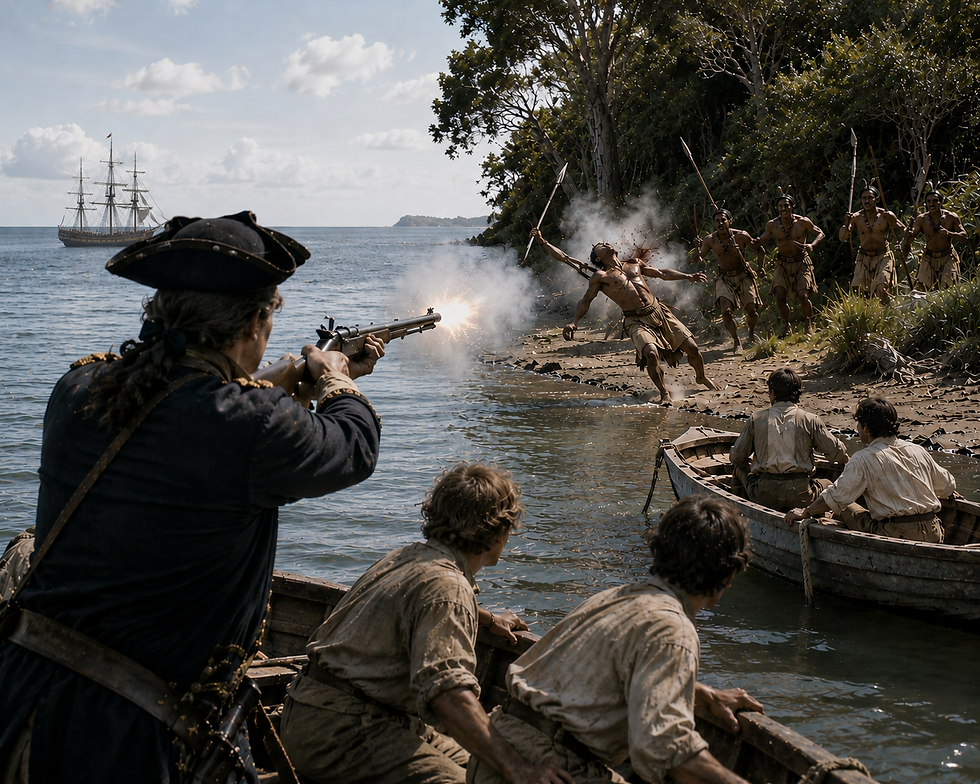
When Captain James Cook stepped ashore at Poverty Bay on 9 October 1769, he was accompanied not by Marines but by Joseph Banks and Daniel Solander, two of the most prominent scientists on the voyage.
Having spent months making largely successful landings throughout the Pacific, Cook appears to have viewed Gisborne as another opportunity to explore, map and make contact.
Instead, the small exploratory party found itself at the centre of one of the most consequential encounters in New Zealand history.
Not an Invasion Force
Popular imagination often pictures Cook's arrival as a military landing.
The reality was rather different.
From Cook's journals, the first party ashore consisted of:
Captain James Cook
Wealthy botanist Joseph Banks
Swedish scientist Daniel Solander
A small number of sailors
At least four ship's boys
The Marines aboard the Endeavour were not mentioned in Cook's journal as accompanying the first landing.
This was not a conquering army.
It was essentially a navigator, two scientists and a handful of sailors stepping onto an unfamiliar coastline at the edge of the known world.
The Endeavour had anchored near the mouth of the Turanganui River that today flows through central Gisborne.
Across the water stood local Māori.
Cook wanted to make peaceful contact.
Two Small Boats
Cook used two ship's boats during the landing.
The larger was a pinnace, a working boat rowed by several oarsmen and sometimes rigged with sail. It was commonly used to transport officers, survey parties and supplies between ship and shore. Based on typical Royal Navy practice of the period, the pinnace may have carried around 10 to 15 men, depending on crew and passengers.
The second boat was a yawl. Smaller and lighter than the pinnace, it was useful for short-distance transport, river crossings and ferrying people ashore. It likely required only a small crew, perhaps three to five men.
Cook does not record the exact number of men in either boat, so these figures should be regarded as informed estimates rather than confirmed totals.
One detail stands out.
Tupaia was not part of the first landing party.
In hindsight, this seems remarkable.
Tupaia was a highly respected Tahitian navigator, priest and diplomat had already proven invaluable during the Pacific voyage. Yet Cook had not yet discovered that Tupaia's language would be largely intelligible to Māori.
That revelation would come later.
Had Tupaia accompanied the first landing, history may have unfolded differently.
The River Problem
After landing near what is now Kaiti Beach on the eastern side of the river, Cook noticed several Māori on the opposite bank.
Communication was his goal.
Unfortunately, there was a problem.
The river could not be easily crossed on foot.
Cook ordered the yawl to ferry members of the party across while the pinnace remained near the river entrance.
The Māori withdrew from sight.
Cook, Banks and Solander continued towards several nearby huts situated a few hundred yards inland.
At this point, history hung on a seemingly routine decision.
Cook left four ship's boys behind to guard the yawl.
Four Boys And A Boat
While the expedition leaders explored inland, four Māori warriors emerged from the trees on the opposite side of the river.
Their intentions remain debated.
Were they curious?
Concerned?
Attempting to seize the boat?
No one can know for certain.
What Cook recorded is that the four men advanced towards the yawl.
Had the boat been captured, the entire encounter might have unfolded differently.
Fortunately for the boys, the crew of the pinnace spotted the danger.
They shouted a warning.
The boys pushed the yawl downstream and attempted to escape.
The warriors pursued them along the riverbank.
The situation was escalating rapidly.
The First Shot
The coxswain of the pinnace now faced a decision.
He fired a musket over the heads of the pursuing men.
They paused.
A second warning shot followed.
This time they ignored it.
According to Cook's account, one of the warriors was preparing to throw a spear.
A third shot was fired.
The man fell dead.
It was the first fatal encounter between Māori and Europeans during Cook's New Zealand voyage.
For a moment, the remaining warriors stood motionless.
Cook later observed that they appeared stunned by what had happened to their companion.
The effect of firearms seems to have shocked them.
The warriors dragged the body a short distance before abandoning it and withdrawing.
Cook Returns To The Boats
Hearing the gunfire, Cook, Banks and Solander immediately returned to the river.
The scene that greeted them was very different from the peaceful contact they had hoped to establish.
One man was dead.
Trust had evaporated before meaningful communication had even begun.
The landing party returned to the Endeavour.
The first day ashore in New Zealand had ended in tragedy.
A Historical Irony
What makes the story particularly remarkable is who was present.
Not soldiers.
Not diplomats.
Not settlers.
The first Europeans to stand on the shores of modern Gisborne were a navigator, a botanist, a scientist, sailors and several ship's boys.
Cook had spent months making contact with Pacific peoples elsewhere on the voyage.
There was little reason for him to expect that Poverty Bay would become one of the most controversial and consequential locations of the entire expedition.
Yet within hours of landing, events had spiralled beyond anyone's control.
The consequences would echo through New Zealand history for more than two centuries.
Today, visitors standing near the mouth of the Tūranganui River can still look across the same stretch of water where Cook, Banks and Solander first landed, and where a routine exploratory mission unexpectedly became a defining moment in the story of Gisborne and New Zealand.


