Strange Death of Captain Cook on Kaiti Hill
Updated: Jun 11

There is something deeply revealing about the fate of the Captain Cook statue that stood on Kaiti Hill above Gisborne for fifty years.
Not merely revealing about Cook. Revealing about us.
Because the story is not actually about bronze. Or plaques. Or whether the sculptor got the buttons on Cook’s naval coat historically accurate.
No. The story is about a modern society becoming psychologically incapable of carrying the burden of its own history.
And naturally, because we are modern people, we handled this with graffiti, committee meetings, press releases, and public moral theatre.
Which is exactly what you would expect.
The statue itself was erected in 1969 during the bicentenary commemorations of Cook’s arrival in New Zealand. It proudly stood on Kaiti Hill, overlooking the bay where Cook first landed in 1769. For decades it functioned as one of those ordinary civic monuments most people barely notice. Tourists photographed it. Children ignored it. Locals drove past it on the way to admire the splendard views of Gisborne City and across Poverty Bay.
And then, suddenly, it became radioactive.
Not physically radioactive, although given modern politics, that may only be a matter of time.
Symbolically radioactive.
Over the years the statue was repeatedly vandalised. Red paint was thrown across it.
Graffiti labelled Cook a murderer and “Crook Cook”. At one point someone painted a bikini onto the thing, which is a very modern form of revolutionary activism. Imagine risking arrest to dress an eighteenth-century navigator like he’s on holiday in The Gold Coast.
Now, to understand the absurdity here, you have to grasp something fundamental about human beings.
We do not merely remember history.
We dramatise it.
We turn historical figures into saints or devils because ambiguity is psychologically exhausting. And Captain James Cook presents a particularly difficult problem for modern Western societies because he represents two truths simultaneously.
First: he was undeniably one of the greatest navigators and explorers who ever lived. A working-class British naval officer who sailed into genuinely unknown waters with astonishing courage, competence, discipline, and scientific precision.
Second: the arrival of Europeans unleashed transformations that brought suffering, conquest, disease, dispossession, and cultural upheaval.
Both things are true.
But modern ideological thinking cannot tolerate duality. It demands moral simplicity.
So Cook must become either:
the flawless bringer of civilization, or
the genocidal avatar of colonial evil.
And because contemporary institutions increasingly reward grievance over competence, the second interpretation now dominates public life.
The irony, however, is extraordinary.
The people tearing down statues almost always live within the very civilization created by the exploratory, technological, scientific, naval, agricultural, legal, and institutional traditions they claim were entirely evil.
They protest colonialism using smartphones. They organise resistance movements through Western liberal free speech traditions.
They condemn Cook while benefiting from the civilization produced by the age Cook helped inaugurate.
Which does not mean colonialism was morally pure.
It means history is tragic.
And mature civilisations understand that.
Immature civilisations rewrite it.
One of the strangest aspects of the Gisborne statue controversy was the obsessive debate about whether the statue even looked like Cook at all. Some argued it was effectively an impostor. Others insisted it resembled early engravings based on official voyage portraits.
Research later confirmed the statue was indeed intended to represent Cook, probably drawing from James Basire’s 1777 engraving derived from William Hodges’ portrait work.
Think about the symbolic absurdity of that for a moment.
An entire society descending into tribal conflict over whether a bronze sailor sufficiently resembled another painting of the same sailor produced 250 years ago.
That is not merely politics.
That is theology.
Secular theology.
Because once a culture loses religious structure, political symbols absorb sacred significance. Statues cease being historical objects and become moral idols to either worship or destroy.
And so the council eventually removed the statue in 2019 and transferred it to the Tairāwhiti Museum.
Notice the language carefully.
Not destroyed.
Not preserved proudly.
Not contextualised robustly.
Relocated.
That wonderfully bureaucratic modern word meaning:“We no longer possess the confidence to defend this publicly, but we are not yet brave enough to admit we are ashamed of ourselves.”
And that may be the central issue.
Civilizations require confidence in their continuity. Not perfection. No civilization is perfect. Every historical society contains violence, cruelty, hierarchy, exploitation, and error.
Every single one.
Including the pre-European tribal structures that modern activists often romanticise into ecological utopias populated entirely by spiritually enlightened environmental philosophers.
Human beings are much darker than that.
Always have been.
Cook himself was neither demon nor saint. He was a naval commander navigating the brutal realities of the eighteenth century. By the standards of his era he was often remarkably restrained. By modern activist standards he remains unforgivable because modern activist standards are designed precisely so nobody in history can survive them intact.
Eventually this becomes self-consuming.
Because if every historical figure must meet contemporary ideological purity tests, then every civilisation ultimately inherits only shame.
No heroes.
No continuity.
No gratitude.
No admiration.
Only accusation.
And societies built entirely on accusation do not remain stable for very long.
One of the more unintentionally hilarious aspects of the whole affair was the proposal by some locals that the statue and the replica Endeavour ships should instead stand proudly in the middle of Gladstone Road where everyone could see them daily.
Which is actually psychologically perceptive.
Because monuments are not merely about history.
They are about what a society chooses to elevate.
Quite literally.
You place things on hills when you want people to look upward toward them.
And that is precisely why modern societies increasingly distrust monuments altogether.
Because monuments imply hierarchy. Achievement. Greatness. Permanence.
And contemporary culture feels safer flattening everything instead.
No giants.
No explorers.
No founders.
No civilizational confidence.
Just endless suspicion.
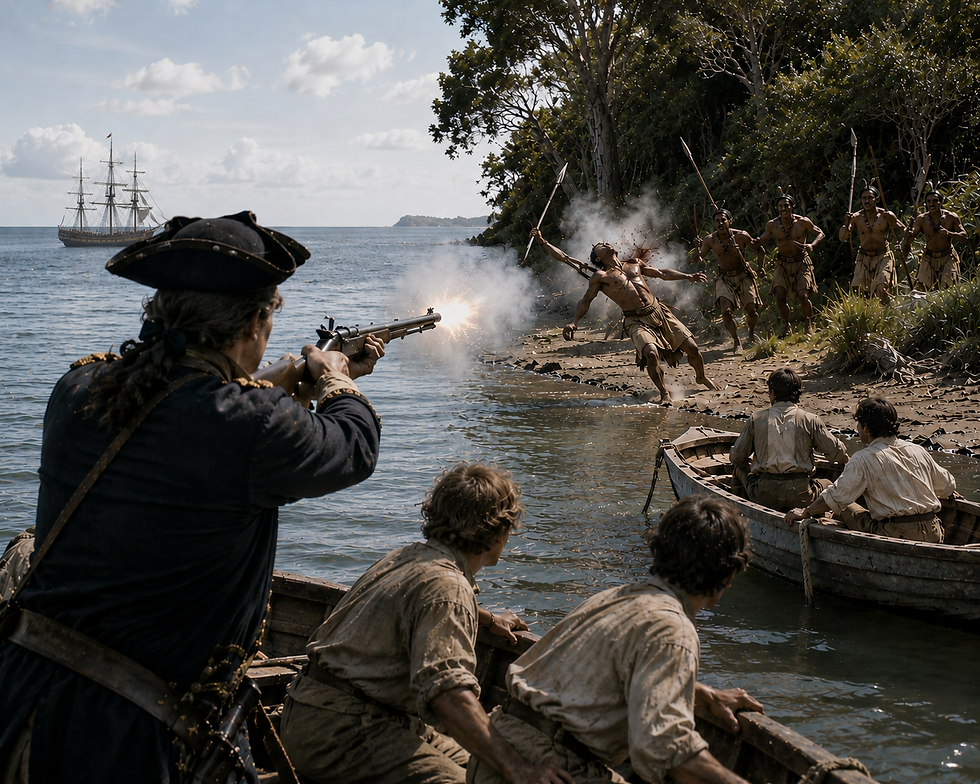
Now, none of this means Māori perspectives should be ignored. Of course not. The encounters at Gisborne involved violence and death. Those events matter deeply, particularly to descendants who carry those memories culturally and historically.
But a mature nation can hold two ideas simultaneously:
that history contains pain,
and that historical figures can remain historically significant despite imperfection.
That is adulthood.
What happened on Kaiti Hill was not adulthood.
It was a civilisation nervously negotiating with its own reflection.
And the result was quintessentially modern:
the statue was neither honoured nor destroyed, merely pushed quietly out of sight into institutional storage where nobody needs to feel too uncomfortable.
Which is fitting, really.
Because increasingly, that is where the modern West stores its own history.