Cook's Endeavour Ships That Once Watched Over Gisborne
Updated: Jun 11

There is something very strange about watching a civilisation dismantle its own symbols while simultaneously insisting it is becoming morally superior.
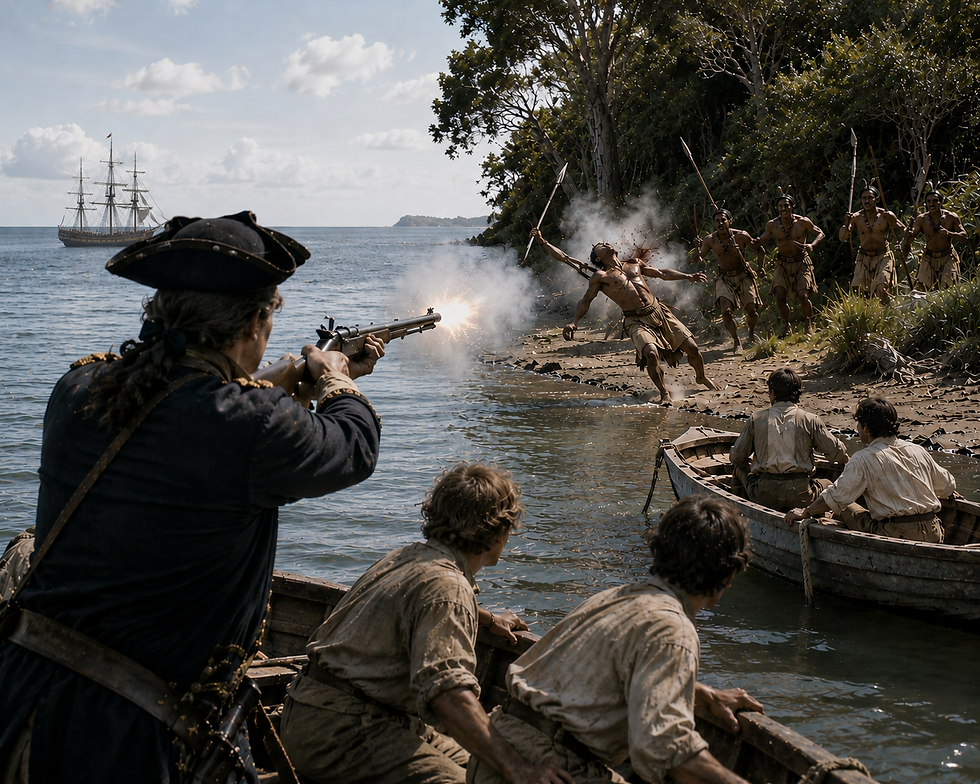
For decades, two replica Endeavour ships stood above Gladstone Road in Gisborne.
Most people hardly noticed them after a while. They became part of the landscape in the same way old churches, war memorials and town clocks become part of the psychological architecture of a place. They were simply there. Familiar. Inherited. Stable.
And stability matters more than modern people understand.
Human beings do not orient themselves merely through laws and economics. They orient themselves through symbols, stories and continuity across time. A culture without continuity becomes psychologically fragmented. It loses confidence in itself. Eventually, it loses memory altogether.
The replica ships were originally erected during the Cook Bicentenary celebrations in 1969, marking 200 years since Captain James Cook’s arrival in New Zealand aboard HMS Endeavour in 1769.
Now, whatever else might be said about Cook, and there are certainly complicated aspects to all historical figures, he was indisputably one of the greatest navigators and explorers in human history.
That matters.
Because modern people have become extraordinarily arrogant about the past.
We sit comfortably inside technologically advanced societies built upon centuries of exploration, navigation, science, engineering, trade and institutional development, and then casually moralise about the individuals who pushed civilisation outward into the unknown.
But exploration is not a trivial thing.
Crossing the world in wooden ships guided largely by primitive instruments required immense competence, discipline and courage. Cook was not merely a symbolic figure. He was an embodiment of the exploratory spirit itself, the tendency of human beings to confront chaos voluntarily and transform it into habitable order.
And that impulse built the modern world.
The replica ships on Gladstone Road emerged during a period when New Zealand still possessed enough cultural confidence to commemorate achievement openly. The 1969 celebrations were enormous: parades, naval visits, flyovers, ceremonies, public spectacle. The country treated Cook not as a moral abstraction to be endlessly deconstructed, but as an important historical figure connected to the formation of the nation itself.
The ships were originally intended to be temporary.
But temporary things often survive when they resonate with people at a deeper level.
Over the decades they became local landmarks. They were repaired repeatedly. Rebuilt. Upgraded. Restored again and again whenever weather and time began wearing them down.
That alone tells you something important.
Communities preserve symbols they feel attached to. Nobody spends decades restoring meaningless objects.
But over time the ideological climate changed.
And modern Western societies have developed a dangerous habit: they increasingly judge the past through the moral vanity of the present.
Instead of attempting to understand historical complexity, many institutions now engage in retrospective purification rituals, where public symbols are evaluated according to whether they satisfy contemporary political sensibilities.
The result is not wisdom.
It is cultural instability.
Because once a civilisation begins dismantling its foundational stories entirely, it risks producing generations who inherit prosperity without understanding the sacrifices, achievements and competence structures that produced it.
Of course Cook’s arrival involved conflict. Of course colonisation brought suffering as well as development. Human history is tragic. Every expansionary civilisation in history contains brutality within it because human beings themselves contain brutality within them.
But mature societies do not solve that problem by collapsing into historical self-hatred.
Nor do they preserve historical symbols because history was perfect.
They preserve them because civilisation itself is an accumulated inheritance, not a morally sanitised utopia.
The replica ships eventually became politically contentious. During the Tuia 250 commemorations in 2019, debates intensified around whether symbols associated with Cook still deserved prominent civic placement. By 2020, after public and political pressure, Gisborne District Council ultimately decided against reinstalling the replicas in the city centre.
And so they disappeared.
Now perhaps that seems insignificant. Two decorative ships removed from above a road.
But psychologically, it represents something much larger.
Because societies reveal their confidence levels by the way they treat their past.
Confident cultures integrate complexity without destroying themselves. Insecure cultures oscillate between naïve hero worship and compulsive repudiation.
What is unfortunate about modern historical discourse is that it increasingly encourages young people to view Western exploration primarily through the lens of guilt, rather than through the lens of extraordinary human capability.
And capability matters.
Without explorers, navigators, engineers, builders and risk-takers, there is no modern New Zealand. There is no contemporary Gisborne. There is no global civilisation capable of supporting millions of lives in relative stability and prosperity.
The Endeavour replicas were not merely celebrating a ship.
They symbolised exploration itself. The willingness to move into the unknown despite danger.
And perhaps that is what modern societies are actually losing.
Not merely monuments.
But admiration for competence, courage and civilisational confidence.